NSFW

I've spent my life trying to understand human behavior and many things about how humans define normative beliefs, boundaries, and build their ideologies and walls. And I've always been fascinated by the ideas and symbols that cause people discomfort. This is a bit of a study over time, in a curated order, of a number of different projects that I've been a part of, or just some art that I did on my own, with imagery that may or may not offend. Each section will have its own context and description, and as well as each image.

If you're so inclined, let's start...

The above links work best once the page has fully loaded.
Once you have scrolled through to the bottom, they will operate properly.
Use the 'Back to Top’ arrow to get back to these links quickly.

Nude Art Night

After ©haos Gallery, I moved into another place with Mecca, a house that she bought. We called it 'The Black & White House’ (logo in the previous logo gallery), and we considered it another collective living space, gallery, performance venue & event space. It was a little further into the suburbs than preferable, but it was an interesting and quirky house, and the price was right.

While still at ©haos, she had also met somebody else named Nova (mentioned in one of the photo comments). Let's just say there were some interesting encounters and a bit of back and forth and statuses of relationships bending and twisting in different ways. Anyway, the event that he was interested in having at the Black & White House was... 'Nude Art Night', a kind of twist on the idea of figurative drawing, where not only might you have a model who was all or partially nude, but if you were so inclined as a participant who was painting said model, you could also dress to whatever level you felt like. They were certainly interesting times.

I challenged myself to see if I could use my digital art skills and create some kind of portraiture of the different models within the time that they were there. Not what I would call graphic design, really. This ended up being more of what I tend to do a lot of between layers, which is use a lot of blending effects and textures, and of course layer effects. There were failures and successes to various degrees, and I've included all of them here, even the ones that I'm a bit iffy on, with some commentary in the photo comments that will tell you why, depending on which one.

I don't know exactly how risque this gallery is, but at the very least, you can certainly see some nipples. So it made sense to put in this part of the site. And I think it's a good entry point before things that are a little bit more intense or blatant.

Mecca — Mecca was a big fan of nudity and exhibitionism, so of course she was one of the people who would hang around naked at nude art night. This is a less obvious version of nudity in the style that I did, but I did come up with this live at the show.
Kitty 1 — To be honest, I was having a hard time coming up with something I liked that actually showed bodies with this one. I like the person a lot, but I'm a picky bitch. I don't even remember if I showed this to her or not. Looks more like an abstract painting than a nude. But that's cool.
Rudy — An interesting enough one. It's quite a challenge to use your digital art skills to come up with something that's actually decent in an extremely short amount of time during an event while people are there. I think this one's okay.
Stacy Quam 1 — I don't know how much I was liking what I was coming up with here. Or the model. She was okay. Just kinda nothingy. Didn't get a real feeling from her. So I think I just kinda created a bit of an interesting mess. It is what it is.
Mecca | Oblivion's Pull — I was literally retarded with love when it came to this insane person. It is so bizarre to realize the level of mental and emotional overwhelm that can happen when nature kicks in that hard. The words I wrote are a bit over the top. I like the piece though.
Kitty 2 — Different event. Kitty again as a model. You can see a bit more. Still felt odd. Maybe I wasn't able to detach myself enough, and it felt weird to see this person naked. So I felt the need to partially cover them up in my attempts to create art of them nude. It's a strange one.
Stacy Quam 2 — The other guy in the relationship triplet that I was in during this time period, named Nova, who was with me and Mecca, intimately, was the one who created this event. The downside of this event is, you don't always attract, I don't know what you want to call it, the best people. Again, same model, different night. I tried. I don't think it's that great, but it doesn't suck.
Kait — This one was different. It helped that Kait set herself up in front of a wall with a bunch of artwork on it, including some of mine, if you look closely. And I'd known Kait for many years at this time and lived with her at The Firehouse. I was very comfortable with this one, and I think I came up with something pretty cool for putting it together in such a short amount of time.
Natasha — To be honest, I did find this one very attractive. A kind of body that I tend to like quite a lot. This one felt easy, but I didn't overcomplicate it. Outside of maybe some people interpreting some of the brown-ish, grungy stuff inappropriately exiting out of a strange part of their body, which was unintentional, I think overall, if you didn't notice that to begin with, it's a pretty neat-looking piece.
Nikki — I don't think I had any feelings either way regarding this person, but I wasn't bothered. And I found a groove of some sort. Even managed to throw some vector art into it. It's the kind of messy that I like. Abstract. Symbolic. It's nice. Decent considering how quickly it was made.

Symbolic Overwhelm

As should be relatively clear by this point, I don't veer away from iconography, symbology, imagery that is shocking or raw or basically off-putting. And while the different galleries you've already seen have gone about whatever intensity they've had in a very different way, these are a different kind of animal. Far more overt, but strangely so overt that they almost simultaneously offend and don't. Check the comments for my specific take on each.

Hope for a Better World — I'm an outsider and an iconoclast, and while living amongst the extreme leftists in the arts, at a later time, after being there for many, many years, I took a whole bunch of the symbols that permeated and were talked about and were described by those that either loved them or hated them, and tried to cram as many of them into one piece of artwork at the same time as I could. No one commented on this when I posted it online. I think there's too much to process, and no one has any idea what to say about it.
Swasti-David — Two symbols that ideologically are in direct opposition to each other, but someone managed to design them into one symbol (not me). I happen to be very attracted to the power of symbols, especially ones that massively affect people. And the idea of this combination intrigued the hell out of me. So, I gave it a treatment. I even posted it online. Didn't get any negative comments for it, but I did give a long explanation.
Swasti-David-Alt — As I'm inclined to do, I also did an alternate treatment. It's interesting, in a way, what I've done to both of these kind of obscures what it is, or at least tones down the directness of it by making it a bit messy. I still think it looks gorgeous, like a strange snowflake. The idea of what it is made out of just seems forbidden and powerful.

Sacred the Munny

So another group show opportunity came up at The Firehouse. This time, because we had for a time a toy store, toy store, in one of the spaces at The Firehouse, right off of the gallery. The guy who ran that store had a good resource for these dolls called Munnys. And he, as a resident, since he was one of the people who was paying for rent at the place, asked us during a house meeting if we'd like to participate in the show. I don't actually remember paying for this thing either, so maybe he had at least a few of them to give out. I don't remember. But this is what I came up with.

At the time, I was definitely in more of a particularly anti-Christian kick. I was reading a lot of Dawkins and Hitchens and Dennett and Harris, otherwise known as the four horsemen. They were kind of peaking at the time. And I had a childhood growing up in various church scenarios and felt compelled in my teen years to also participate in that for a bit until I got very tired of all the dogma and because of the way I think about reality, the inconsistencies became far too intolerable. I even ended up getting into an argument with six different pastors simultaneously on a visit back to that same church. And I held my ground.

So when I saw the Munny, a concept came into my head because I think of very weird things. And I imagined a double-ended dildo as basically horns. But instead of it being nailed to the cross, there is a Prince Albert at the tip going right through the, what would be a urethra, and that is chained to the cross with eye hooks, with an eye hook. It is a very striking, very sacrilegious. It's got green upside-down crosses all over it, and the little dude looks like a kind of demon / angel. So it is a form of a crucifix. And I built all of it with wood and a fuck ton of screws. There's a crown of screws, and there are screws going into his feet, into the platform he's standing on, all representative of the same kinds of things that Christianity and Catholicism tend to like to show, and especially Catholicism with the crucifixion. And as a note with that one, I've always found that particular imagery to be a really bizarre thing for a religion to have as its primary symbology, the celebration of the death of your savior. It's bizarre.

I also said that I've got some other larger-scale sculpture ideas that I'd like to do. Creating this sculpture inspired a very different version of it. What I imagine is the pretty well-known hypercube that Dali created, which is a crucifix and what looks like a three-dimensional cross with Christ suspended on it. It's got the same kind of dimensions made out of cubes coming forward, back, side, side, up, down, but it's technically a four-dimensional object unfolded into three-dimensional space. So not the hypercube you see that constantly folds in on itself, basically the shadow. The idea being is that I would have the larger version of this doll with even bigger double-ended dildos, and there would be four of them. As the sculpture would be a three-dimensional cross, there would be one suspended off of the edge of each of the cubes around it. Or if not that, in between them, and then inside each of the cubes would be a glass panel, which would effectively be a light box, and each panel would be filled with different forms of paraphernalia and objects that most people would consider to be offensive or disgusting. The idea being is to use as many offensive types of symbology, iconography as possible, all in one thing, but do it at a really high skill level and a high level of refinement, make it impressive as hell. It included the idea of having a subwoofer built into the bottom part of the cross, and as a kind of joke, as flash photography was still kind of a thing at the time, I'd also come across four flash bulbs that I was going to install into the sculpture so that whenever anybody wanted to take a picture of it and tried to, when they clicked their own flash, all four of those flash bulbs would go off, completely bleaching out any attempt that they had at trying to get a photo of it, just to offend in a different way.

Anyway, I tend to be a little bit less offensive nowadays, but I still think this is a very, very rad sculpture. I think it does exactly what it means to do, and this section of the website is definitely a filter. If this puts you off, you're definitely, probably not going to want to work with me. But I want to be who I am, so I am showing who I am. Someone who's fascinated with consciousness, experience, life, what it means to be alive, and experience anything, who's always been into philosophy, physics, science, and finds belief to be one of the biggest problems that this world has. At this point, I'm not really anti-religious as much as I am anti-belief. And at the same time, due to the current socio-political climate happening between the West and other factions in the world, I've grown a lot more respect for the fact that Christianity, after having gone through modernity and been mellowed out over the centuries, is acting, at least in this country, as a bulwark against the incursion of other ideologies.

So, I am a different person now. At least at this point, a little bit less interested in overtly offending. Although I can't promise I won't end up designing or building something in the future that might have that as a part of its purpose.

Sacred the Munny — Front on shot, while on display at the Firehouse Gallery during the Money Show. Upscaled, as all of these are, with as much correction as I could do. Cameras at the time weren't that great, but I wanted to preserve images of this. The shadows, they are amazing.
Sacred the Munny — In this shot, I'm just trying to get a little bit of a close-up on some of the main details. The crosses painted onto the ends of the main cross, with the one at the top being painted on upside down, and one more on the pedestal that this Munny doll is standing on. The rings, cock rings if you like, on either side of the head, acting to hide a bit of the cutaway into the head. The crown of screws. The Prince Albert piercings. It's an intense sculpture.
Sacred the Munny — Bit of a side perspective. Give it a bit of depth and dimensionality. Image quality's a bit messy, but I think it still conveys the intensity.
Sacred the Munny — Same angle pulled back a bit more. Shows more shadowing. More of a dramatic shot.
Sacred the Munny — Another front shot, framed so that the shadow is a major part of the composition. Very dramatic. Really adds to the symbolic nature of the presentation. Those spiky shadow pieces you're seeing are the cuts that are in the platform that the Munny is standing on.
Sacred the Munny — Another left side angle shot, kind of close up, framing in on mainly just the Munny itself on the platform. Quality's not great. Looks kind of comical, like a filter's been applied to it, but still looks a bit intense. And you can slightly see the wings that he has in this one.
Sacred the Munny — Tight framing front shot. Camera I had? Yeah. Not the greatest. The colors are great though. That purple is really popping right now. Funny note, that double-ended dildo turned brown over time. Somebody did buy the sculpture, and eventually gave it back to me. And when I got it back, those things were ruined. Not because of UV, just time. Still haven't found a replacement for them.
Sacred the Munny — What wasn't revealed yet was that this was a full show of munnies at The Firehouse. Everybody opted to build pretty small and far less offensively. I kind of dominated the show unintentionally. Not sure how many people were affected by the imagery enough to really put them off either. But that was kind of the point.
Sacred the Munny — That's a bit of a cleaner front shot. Probably more gallery lights on because this was the actual show. Previously, I just had it hung up in the gallery by itself. And the angle's nice, you can really see the cutouts I did in the platform. This thing was built like a tank, too. That's a lot of hardware and a ridiculous amount of screws.
Sacred the Munny — Well, since it was such a shitty camera, might as well get a close-up here. Even got some purple reflections in those steel plates. You can really see those screws going into his head, and that veiny texture in that double-ended dildo. This honestly was a very fun project to build.
Sacred the Munny — Now we get to see a downward angle showing the platform itself with the green upside-down cross on it, and the green upside-down cross on the Munny's forehead. Also note, his feet are screwed into the platform. This is a crucifix. It's appropriate. Little wings budding out on the sides too. A bit angelic and demonic.
Sacred the Munny — Dramatic upshot angle. Not sure how much it does for the presence, but it's cool to see, at least to get the build of the sculpture from a different angle, see how the different pieces are attached to the cross.
Sacred the Munny — I do kind of overshoot things at times. And I think I did that with this one, just to make sure that I had as many interesting angles as possible. You can see how thick that cross was, and the platform. I bet that was, I don't know, five-eighths to three-quarter inch thick wood. Pretty soft wood though. But with all those steel brackets and plates and all those screws, and the eye hooks, it's a lot of metal and wood. It was relatively heavy for the size.
Sacred the Munny — And the last shot. Not a new angle, but during the actual show. I love this sculpture. I have a whole 'nother idea for one that is much bigger, and instead of using a flat cross like this, would use Dali's three-dimensional hypercube-based cross, and four different Munnys. And they have the Munnys at a much bigger size. One day. It'd be a pretty intense sculpture.

Pentagrams

Ah, the good old pentagram. Satanism and all that. These made-up ideas from people who like to project fear onto their followers in order to compel them into behaving well. One of the older control systems that this species developed early on. Perhaps not necessarily this particular symbol or Satanism itself, but some version or some form of that.

It just ends up making me more interested in how something so simple can have such a powerful and offensive effect on so many people. It's because of belief. And so, when I was younger, I explored these ideas extensively. And this is some of the art that I came up with.

The double pentagram, or whatever it should be called, is still incorporated into my primary and original symbol.

Chaos Pentagram Duality — Is this symbol controversial? Or does it require being in an NSFW gallery? I don't know. For me, I found it interesting to take a symbol that, for most people, whether right side up or upside down, whichever one of those is true, and combining two of them into one, stood for the duality that the universe is full of. This is a very old version, early days of Photoshop. You've seen other things like it already in previous sections.
Double Pentagram | Purple-Green — The only version of this that I had from way back in the day when I originally created this with it by itself was way too shitty to even bother trying to upscale. So I actually built this one while putting together this website. I really like the way that this symbol is confusing. I think this is partially what led to me making the version of it coming up in the next images that's in 3D, and why I integrated it into my first main personal logo.
3D Pentagram — Not the perfect upscaling. I never had a chance to render this at a higher resolution. And does it even belong in this space either? If you didn't know what it was, you would be hard pressed to be bothered by it. But once you do, it's kind of fascinating what it looks like when a bunch of pentagrams are put together into a 3D object that looks like a buckyball. And hey, why not have it float in space?
Ball Pentagram in Space — A slightly rough upscale, but not too bad. Building a 3D pentagram out of spheres and poles and a torus. Putting fire on the primary balls, floating the whole thing in space. Again, it's fascinating how offended people can be by a symbol made out of five lines. Just an interesting aspect of human consciousness that I find unendingly interesting.
Pentagram | Dark Scene — Made a long time ago, as all these were. And with this one, I was trying to more closely elicit the kind of imagery that people can be so afraid of. Made out of some kind of wood texture, almost taking on the appearance of something you might crucify somebody on. Designed to look dark. Really though, it's quite a lovely object. And without the connecting beams, it's just a star. It's funny how subtle the difference is between this being a potentially offensive object and a kid's shape.

The Kitty Collection

Before and during The Firehouse, in its early inceptions, there was a previous space called Thoughtcrime. Basically, a variation on a theme, run by the same guy who ran the Firehouse, and technically his second or third version of this kind of collective living experience. I was in a different previous relationship that was dysfunctional, tumultuous, and weird. And at some point I had an opportunity to show a bunch of my pieces, which for the most part were the older ones that you've seen already, lots of the older chaos symbols that I had from the 90s that I'd figured out how to scale up and print before the advent of AI upscaling to a decent quality level.

In this relationship, things were inappropriately open and strange. I would never even say that we were technically officially anything, but we did live together for quite some time and spent the majority of time together for four years. So, whatever that means. And at some point, this concept came into my head. Like other things that humans have a revulsion to for whatever reason, even more so than the male phallus, women's parts seem to be scary to most people. And I figured it might be interesting to use some of the things I had understood with Photoshop to develop some treatments and make them into art.

At the very final show before Thoughtcrime closed, I was the artist. I picked nine of these, or maybe she did, I don't remember... bought frames, and this was one wall, one that fit the nine panels nicely in a grid, three across, three down, and showed that for part of it, and then showed my other pieces on the other walls.

Keep in mind, this is at a very, what one might call countercultural, semi, not really, but sort of cult-like environment with people who were hyper-liberal, progressive, etc. And apparently, what I heard about after the fact was that they were not exactly super comfortable having nine vaginas on their wall. So, even in the most liberal of circles, I have tended to push some boundaries artistically, which to me is both fascinating and odd, as-as far as I understood, this group, this type, this clique, this subculture of people who were not a part of the theocratic aspect of this country's culture, should be far more open to this kind of thing. It's strange. It's like the idea that people are far more accepting of death and violence than they are of sex. Something to do with Catholic shame and the way that the Puritans, I guess, left England and were a big part of founding this country, and kept that kind of thinking going, which has obviously continued to permeate throughout the culture, even to this day.

As with everything in this section, I considered not showing it, but this is not a standard just show the most appropriate kinds of things to people in order to build or connect to people who might be interested in partnerships or employing me. I'm building something that shows how I think and who I am, who I am as a systems thinker, and I don't want to end up in a position where everything sucks and everybody's uncomfortable, and we both regret me being hired and you hiring me, or me finding a partner and us working together. You know, like I said with most of the stuff in this section, I'm not currently doing this exactly, but if you look at even the most recent pieces in the chaos system section, the parts made out of octopus, I don't know, I'm thinking that might be off-putting for a lot of people as well, and I think it looks amazing. So, what do I do? Hide it? Pretend that I'm somebody else? Be disingenuous and fake? Not expose the progression of who I am, my troubles, my tribulations, my adaptive capacity to get through all of these things and continue to grow as a person, and express in weird ways while doing it? It doesn't make any sense, so I'm showing this stuff.

Check out the comments and see what you think.

Kitty | Red-Black — A bit more obvious? Maybe. Certainly adds a bit of temperature to it. Perhaps implying body heat? Thermal? A color inversion. Still kind of obscured though. Still fascinating. Or maybe you find it gross, I don't know.
Kitty | Fishnet — This one looks far more obvious the further away from it you see it. Up close, it's still pretty obscured. Some kind of a painting effect was used. Desaturated completely, and then a bit of a fishnet effect with some blending layers to give it dimension and attach itself to the contours of the flesh. Abstract. I think people consider fishnet sexy. Not sure that's what this is supposed to be.
Kitty | Clouds — Obscured by clouds. The pattern kind of masks, maybe makes your mind a little bit less focused on what it is you think you're looking at, which is kind of the point in this collection. Is it offensive? Is it natural? Keep going if you want. They do get interesting.
Kitty | Plaid — Now it's made out of plaid. It's a fabric with a ring sticking out of it. Does it bother you less now? Is it more weird or less weird? I just think it's interesting. Let's check out the next one.
Kitty | Peacock — The peacock, aligned with the flesh in an interesting way. The name of which, too, has a kind of vulgarness to it unintentionally when used in this way, while it also does a pretty good job of obscuring what it is you're actually seeing. A pretty interesting texture to apply as a treatment in this series.
Kitty | Purple Green Lace — An interesting lacy repeating pattern, getting smaller as it goes towards the center, kind of drawing your focus in on the purple skin, offset slightly with a shadow, but still contouring. This one's interesting, kind of a cage, kind of a shield, kind of a doily fabric. Who knows? It's a trip.
Kitty | Cheeta — And now, a mammalian animal print on a human genital. Does this expose it more? Does it make it more animalistic, primal, sexual? Or is it still just artistic? I don't know, but I think it looks kinda neat.
Kitty | Glowing Edges — An easy and fun effect in Photoshop. The old standard glowing edges. Definitely obscures what we're looking at. A bit of a distortion in the upscale, but it works. Kind of looks like an abstract painting. Even though the piercing ring is kind of obvious in this one.
Kitty | Snowflakes — This is definitely my least favorite of the whole collection. Not because I have anything in particular against snowflakes, but because it did the worst job of looking like it was actually a part of the skin and the flesh. It feels like lazy compositing to me, and I would choose not to show it except for the fact that I also want to show what this looked like when it was hung in a gallery. So in order to have the whole collection, this one has to be included.
Kitty | Snakeskin — Not sure this looks like actual snake skin, but that's what I called it at the time. It seems to contour to the flesh relatively well, but it is a kind of covering, like an animal with fur or a very strong print. If humans had this as their flesh color, would we be bothered by their nakedness as much as we are? Something to think about.
Kitty | Satin — Now, here's an experiment in proper obscurity. If you had no context with the other ones, you might be hard-pressed to know what this was. It was never shown in isolation, so you do. But it's an interesting way to do it.
Kitty | Chromed Difference — A bit of literalism in the title here. A combination of a chrome effect plus the blending effect of difference. Maybe more to it, but it definitely obscures some things. Again, looks like an abstract painting. Kind of flowy, glassy, liquidy. Is it unoffensive now? Maybe not. Maybe you're only still looking at these kinds of things because they don't offend you. That would be my preference. These things are a filter. That's why I'm showing them.

Kitty Collection | Show Photos

When I was interviewed about having a show at 'Thought Crime', a gallery and collective living space that the guy who ran The Firehouse also ran before and during the beginning of Firehouse, I never brought up this collection. All I had really to show was some of my older archives of work from the 90s, a number of things you've already seen with chaos symbols and 3D spaces. But I decided to make an impact, and with the help of Amber, the subject of this collection, built this all out.

The installation was a bit of a pain. Specifically because all of the frames were the exact same size, and any inconsistency would be painfully obvious. So, my method for ensuring that it was all correct was, I think, to get a laser, but that's not really the important part. I used Blu Tack, the sticky Play-Dohy stuff that you can stick on walls and stick things to. And basically, I mounted with screws into the wall for every one of the pieces, and then a couple pieces of Blu Tack on the back so that I could level them all to each other exactly right. Turns out, later on, I find out that removing all of that Blu Tack was a pain in the ass. Not for me, but for the gallery. I think it took some paint off. Also, like I mentioned, this wasn't what anybody was prepared to see. However, I do think that the presentation is fantastic.

Twelve shots, with the gallery above reflecting the same order as was shown in person.

The Kitty Collection | Wall Mount Installation — Not the best photo I've seen, but it is what I have of it. I don't even actually know where these original prints are. I may have given them to Amber, which I guess would make sense. Because I don't think I would be showing these again, for a number of reasons. For one, it is very personal, so I'm, you know, just gonna hang the vagina of an ex up on my wall somewhere? That's a bizarre one. Not that I'm really totally opposed to it, but I'd have to be a little bit more specific and maybe just do a couple of them. I could see doing that. Anyway, it went up and looks excellent.
The Kitty Collection | Wall Mount Installation — It only seemed appropriate that I should include a photo that actually has Amber in it. At least then there's a reference to whose parts one is looking at. She's a cute short one. A bit crazy, literally. Sometimes better than others, but yeah, that's the subject.

Lovely & Vulgar

The final two in this strange section of my website. One is personal to me, and one is not. Although I do know the person, and she was the one who was modeled in the previous section. It is art, even if many would be offended by it. And it is me. Take it or leave it, really. The piece on the left was made back in the 90s. early Photoshop days. Piece on the right, in the aughts. And no, I haven't made any more of these kinds of pieces since. But who knows.

Possession — Yeah, this one is absolutely overt. But that's not my hand. That's somebody I was with for a long time when I was young. And I'm a strange person, so I thought this would make an interesting piece of art, which I've even hung on the wall at The Firehouse. It's so blatant, and yet so strange to have been made into something like this, not something one normally sees. It's hard to even call something like this pornographic, because it really isn't. But what is it? Is it still offensive? Probably to many people.
Swallowing Life — A photo sent to me by someone I was with for a while, and an experience that they were having during a very reckless part of their life. It was odd, that relationship, and what most people would call highly inappropriate to have been sent such a photo. But I made something interesting out of it. Is it not clear what it is? I think it's a pretty dramatic look, and quite intense.

Firearms

This page contains some of the most symbolically charged work on this website.

Firearms. Religion. Money. Politics. Sexuality. Authority. Chaos.

These subjects carry an unusual emotional weight. Most people develop strong reactions to them long before they develop a detailed understanding of what they actually represent. That has always interested me.

The work here is not an attempt to provoke for its own sake.

It is an invitation to investigate why certain symbols possess so much power over our perception in the first place.

Throughout my life I have found myself returning to the same question in many different forms:

Can I participate in the development of my own understanding, or will I simply inherit someone else’s?

Over time I realized that this question connected almost everything I had ever become interested in.

Not because the subjects themselves were related.

Because they all forced me to examine the relationship between authority, understanding, responsibility, and human agency.

A Survival Strategy I Didn’t Know I Was Building

As a child, I wasn’t searching for a philosophy. I was trying to survive.

I grew up as a Gen X latchkey kid with a highly sensitive nervous system, very little guidance for understanding what I was experiencing, and long stretches of time spent figuring reality out on my own.

The world often felt emotionally and cognitively overwhelming. Since no one could build a survival strategy for or even with me, I had to build one myself. Eventually I discovered something that consistently worked. Whenever something frightened, overwhelmed, or emotionally dominated me, I dismantled it.

I broke it apart.

I tried to understand how it worked.

The better I understood something, the less power it held over me.

I wasn’t trying to control the world around me. I was changing my understanding of it until its power over me changed automatically. At the time I had no language for what I was doing. I certainly wasn’t thinking about authority, constitutional design, systems theory, or philosophy. I had simply discovered, through necessity, that understanding could produce a kind of stability that control never seemed capable of providing.

Looking back, I think that realization quietly became the foundation beneath almost everything else.

Why Authority Became Difficult to Accept

Because this survival strategy actually worked, it changed something much deeper. When an adult explained why something mattered, I usually listened. Explanation invited participation. It expanded my understanding. But when someone demanded obedience without explanation, something in me rejected it almost automatically.

As a child I couldn’t have explained why. I didn’t know the difference between legitimate and illegitimate authority. I simply knew that surrendering my own participation in understanding reality meant abandoning the only strategy that had consistently helped me remain psychologically stable.

There were times when refusing to comply resulted in severe physical punishment. That punishment never convinced me the authority itself had become legitimate. Instead it revealed another pattern. When power cannot adequately justify itself, it often falls back on coercion.

Sometimes physical.

Sometimes emotional.

Sometimes social.

Sometimes institutional.

Violence is only one expression.

The deeper pattern is that when legitimacy weakens, coercion often increases. I didn’t understand that consciously as a child. I only understood that my own experience kept reinforcing the same lesson.

Understanding reduced fear.

Unexplained authority did not.

Chaos

Long before I investigated chaos theory, I was fascinated by the word chaos itself. Words like chaos and anarchy seemed to possess extraordinary symbolic power. People reacted to them immediately, and the media repeatedly used them to generate a specific reaction…

Fear.

Whenever I encounter an idea that reliably produces strong emotional reactions before most people can explain what it actually means, I become interested in understanding it for myself.

That curiosity eventually led me to chaos theory and understanding what anarchy actually is, and while anarchism and anarchy did a lot for helping to understand the social relationship between power and authority and people, and went far in describing much different possibilities when it came to how human social systems could be organized, chaos theory did something far more consequential.

It became one of the first frameworks capable of organizing observations I had already been making independently. It revealed something profoundly counterintuitive. The most durable forms of stability in complex systems rarely emerge through increasing centralized control. They emerge through distributed participation, continual feedback, adaptation, and the capacity to correct error.

At smaller scales and over shorter periods of time, increasing control often appears to create greater stability. Our instincts evolved under exactly those conditions. But civilizations, ecosystems, economies, constitutions, neural networks, and biological evolution all operate at scales where entirely different principles begin to dominate.

Chaos theory did not become important because it explained everything. It became important because it was the first systems framework large enough to connect many different domains that had previously seemed unrelated. It eventually became one of the cognitive foundations of what would later become The Chaos System.

Decades Later

Over the following decades, that same pattern continued. Every field I became interested in eventually turned into the same investigation.

Psychology.

Religion.

Economics.

Culture.

Technology.

Music.

Civilization.

Power.

Every domain became another opportunity to ask the same underlying question:

Why do human systems repeatedly drift toward structures that become increasingly difficult to question or correct?

That investigation, plus many of the understandings I gained through my examination of anarchistic systems, which fundamentally attempt to remove the state entirely, it eventually led me to write Boundary Conditions for Human Emergence (found on the AI page).

At the time I believed I was attempting something entirely original. I wasn’t trying to design a better corrective mechanism. I was trying to understand whether the problem itself could be removed.

The more I examined civilization, the more I came to suspect that scale itself continually generates the very conditions that require increasingly elaborate systems of management, authority, and correction. Rather than asking how those corrections could become more effective, I began asking whether a different social architecture might make many of them increasingly unnecessary.

Whether that proposal ultimately succeeds is for others to judge. What matters here is the continuity of the question. The investigation never changed. Only the domains did.

Why I Began Researching Firearms

For most of my life I never felt a need to own firearms. Not because I believed society was fundamentally stable. By that point I already understood civilization as a complex, imperfect equilibrium rather than a permanently secure structure.

What changed was my assessment of the trajectory.

I became increasingly concerned that certain patterns of ideological certainty, institutional capture, and attempts to reshape society around predetermined conclusions rather than continual correction were making the possibility of serious instability more plausible.

Whether that assessment ultimately proves correct is less important than what it motivated me to do.

If I genuinely believed conditions could deteriorate to the point where I might have to be more responsible for protecting my own life or the lives of people I cared about, and knowing the state was ill equipped for that role, then this responsibility required understanding.

That decision led me to investigate firearms. Not because I was attracted to violence. Because I believed responsibility begins with understanding the consequences of what we may one day be asked to carry.

Learning about firearms inevitably led me toward constitutional history, legal responsibility, the Second Amendment, and the broader architecture governing the relationship between individuals and governmental power.

That investigation produced one of the most surprising realizations of my life.

Discovering a Familiar Architecture

While investigating constitutional principles as a direct consequence of researching firearms, I realized I was looking at an institutional architecture attempting to compensate for many of the same systemic tendencies I had spent decades trying to understand independently, and how key this relationship was tied to gun ownership.

Its premise was not that government creates rights. Its premise was that governmental power itself requires continual constraint because concentrated authority naturally tends toward self-preservation.

Power must remain accountable.

Distributed.

Inspectable.

Correctable.

What surprised me wasn’t the principle. It was discovering that an institutional architecture had already attempted to compensate for many of these same tendencies more than two centuries earlier. It did not convince me that the problem had been solved. If anything, it reinforced my belief that large-scale systems require continual correction precisely because scale itself continually regenerates the underlying problem.

What it changed was my understanding of the Constitution. I no longer saw it simply as a governmental document. Or guns simply as a self defense tool. I began seeing it as one of the most ambitious attempts I had ever encountered to compensate for the recurring tendency of power to consolidate itself.

That realization also fundamentally changed my understanding of the kind of conservatism aimed at preserving those underlying design principles. Not conservatism as resistance to change. Conservatism as preservation of the architectural conditions that make liberty itself more likely to survive. That distinction mattered enormously.

It also revealed something else. Even institutional architectures explicitly designed to constrain power cannot maintain themselves automatically. Cultures drift. Feedback weakens. Foundational principles become less visible. People gradually stop remembering why particular constraints existed in the first place. They start believing that they understand a better way than the founding fathers did.

The very success of a corrective architecture can eventually encourage complacency or disregard toward the conditions that made it necessary. That isn’t unique to governments. It is a recurring tendency of complex systems generally, and often emerges because the people within those systems believe that the structures of control that they've developed are the reason why those structures have remained stable, completely misunderstanding the nature of the stability that has been maintained so far.

Recognizing that tendency gave me a very different appreciation for constitutional design. Not because I believed it permanently solved the problem. Because I recognized it as one of the clearest historical attempts to compensate for it.

Why Firearms Matter

This story isn’t primarily about firearms. Firearms became one of the most overt and visceral expressions of a much deeper principle. They're physical manifestation and associated real world consequences are something that we can't convince ourselves don't exist.

They forced responsibility to become concrete. They demanded an understanding of consequences beyond just their own.

Law.

Mechanics.

History.

Self-preservation.

Symbolism.

Individual agency.

Institutional authority.

Nothing remained abstract.

That experience reinforced something I had already been discovering for decades. Understanding changes the nature of intervention. The better a system is understood, the less it needs to be dominated and the more intelligently it can be worked with. Good engineering does not force reality to obey. It works with the principles already present within the system.

The same is true of biology.

Psychology.

Music.

Complex systems.

Constitutional design.

Human relationships.

Understanding does not eliminate action. It transforms the quality of action. Smaller interventions often become more powerful than larger attempts at domination because they work with the architecture of the system rather than against it.

Full Gallery

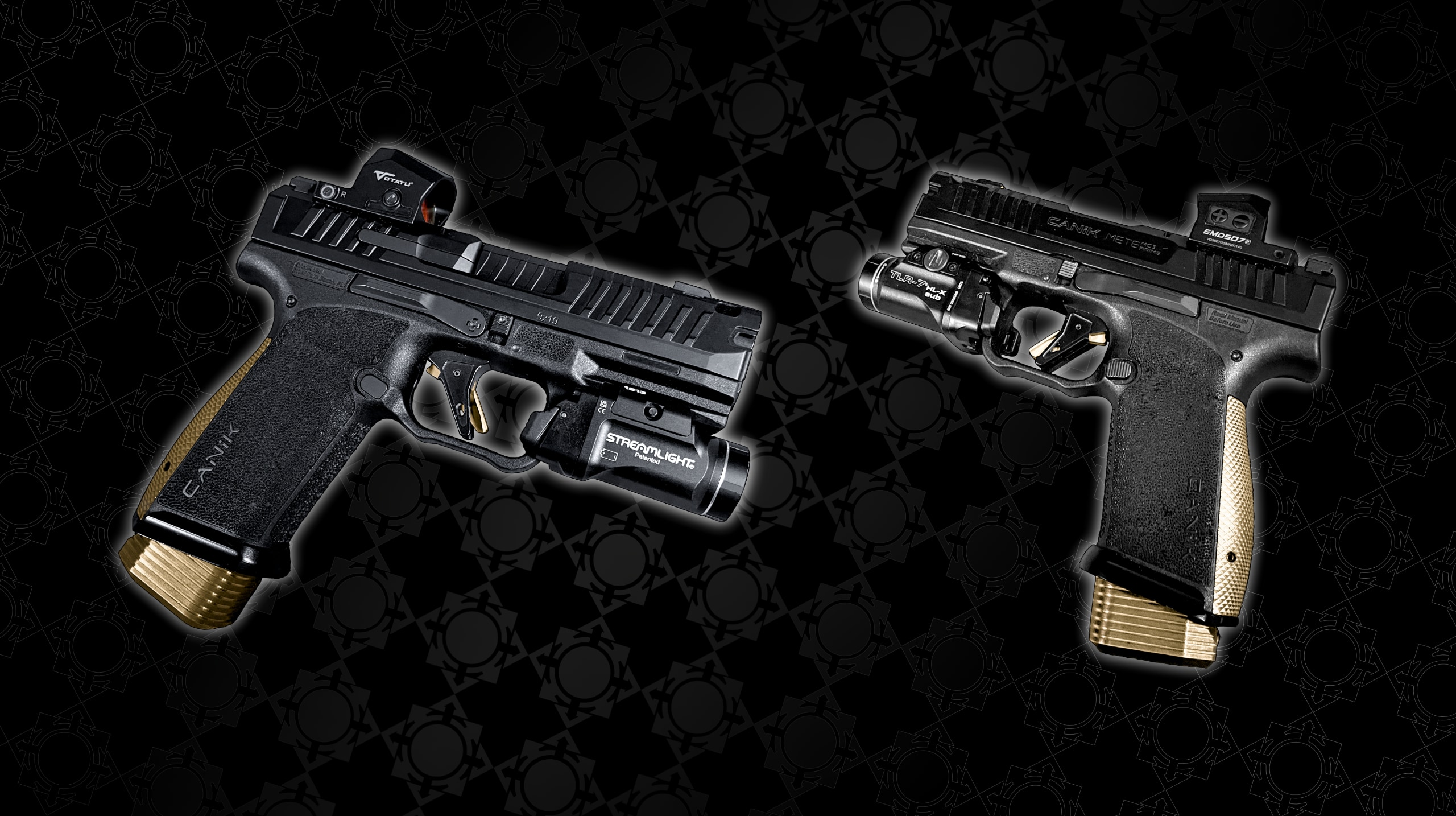
MC9 Prime | Simultaneous Singular Duality — What we're looking at is basically a kind of skills test. These photos were taken with my iPhone under less than ideal lighting, although I do have studio lights that I used that I just happen to have as my main lights in my room. There is color correction involved. Anything that has color has been individually extracted as its own layer. So the red glint in the optic is a layer, the gold of the trigger is a layer, and the brass on the backstrap and the extended magazine is a layer, and then the rest of it is a layer on both of these, which is the same firearm from both sides. And then the background is a continuing development of an aesthetic field of Chaos symbols that, of course, you have seen in many places on this website in different developmental stages.
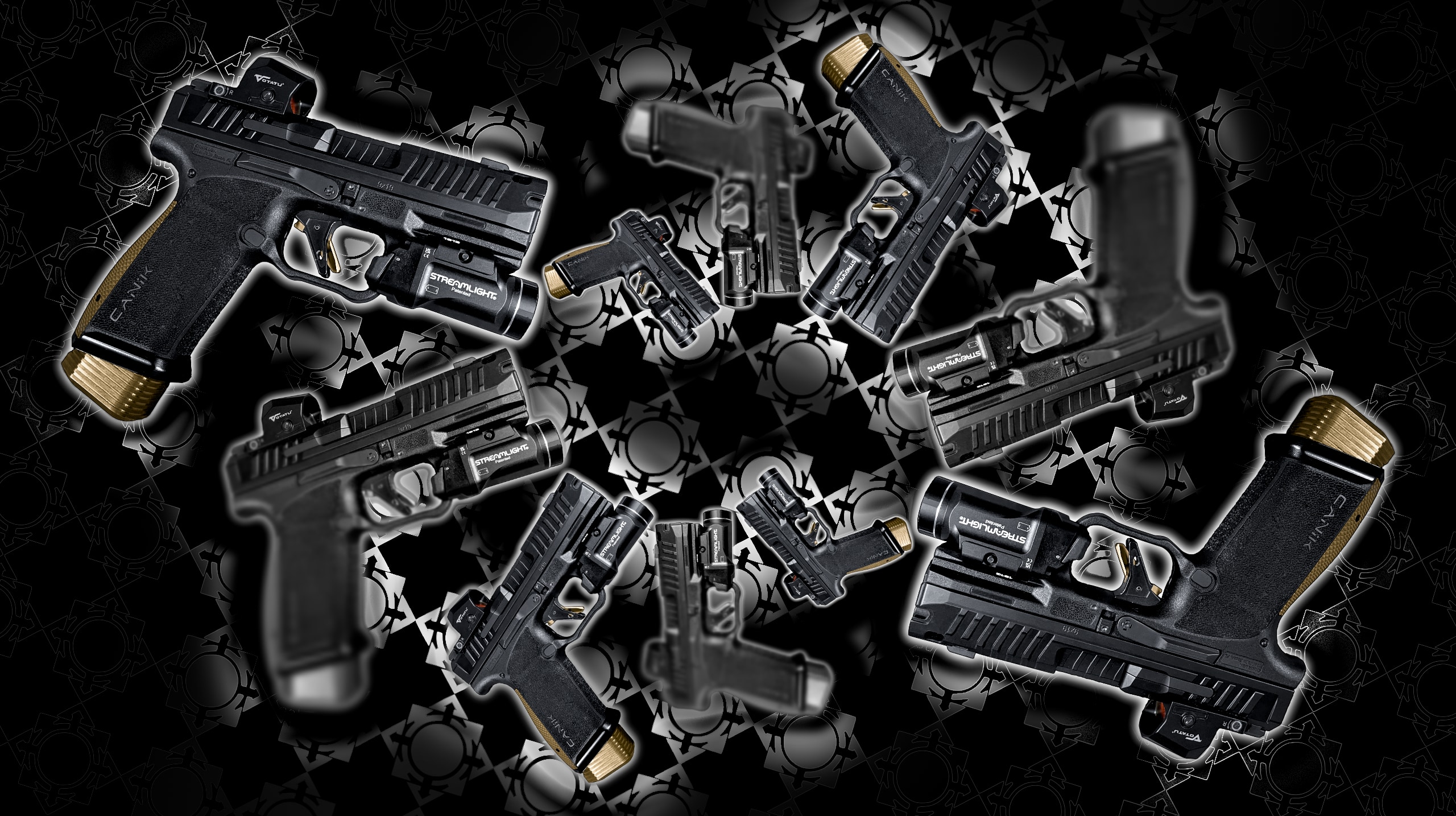
MC9 Prime | Disempowering Through Artistic Intepretive Expression — I don't always know why I create things that I create, but if it's something that is happening in my life that has a significance to it, turning it into some kind of artwork, because it's a way that I do express, often becomes a thing I will do. As part of my interest in understanding this domain as something that should not inherently be threatening, this is an effort to have some fun with it. And if part of the result is that the kind of negative impact that a certain type of person with a particular ideological bent has might feel, disempowers some of that negative energy, then I'm also accomplishing something.
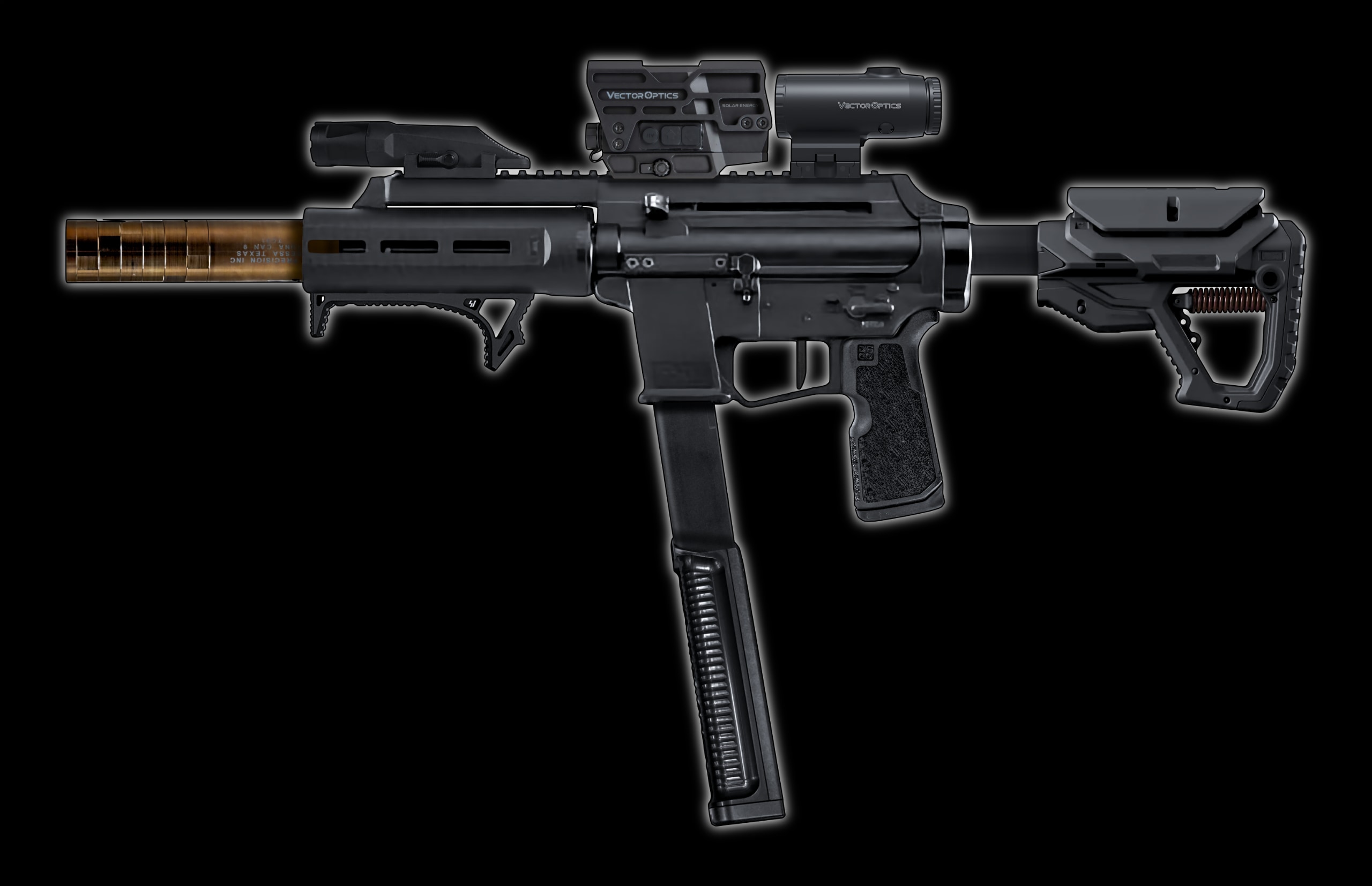
Extar EP9 Build | Predictive Render — What's interesting about this image is that it is a predictive mockup. It's something that I have constructed from all of those individual pieces without knowing for sure what their actual size is, and using intuitive judgment to put something together in what at the time I thought would look like a completed form of a system build. It's an interesting process, and I like building out a vision that I'm potentially working towards. But what's even more interesting is seeing how things actually turn out versus what I might have thought they would have.
Extar EP9 Build | Penultimate Cohesion Render — This is probably the second to last version of what this will look like as an incomplete system before a final version of it is created that is the actual final form. The difference between this one and the last one is that almost everything on this one is real, except for one thing, and that is the suppressor. I'm still waiting on ATF approval for that. I have also received ATF approval for turning this into an SBR. So, in the next iteration, I no longer have to avoid photographing and working with this with an actual stock that I have purchased for it while still feeling comfortable superimposing and imagining the exact same stock onto a photograph that I've grabbed from online, because one is a model and one is actually showing something that really exists.

The Thread Running Through Everything

This is ultimately why this page exists. Not to persuade anyone toward a political position. Not to celebrate controversy. Not to offend. And not to ask anyone to trust me.

It exists because symbols possess power.

Authority possesses power.

Language possesses power.

Ideas possess power.

The question has never been whether those powers exist. The question is whether we inherit our relationship to them unconsciously or consciously participate in developing that relationship ourselves. If something can emotionally dominate us before we understand it, then it already possesses a kind of authority over our perception.

Investigating it is one way of recovering agency.

I don’t think my life has been a story about rejecting authority. It's been a story about understanding the importance of refusing to surrender participation in your own cognitive development. The child who had to build his own survival strategy eventually became the adult who refused to outsource his own understanding. Everything else on this website emerged from that same process.

If there is one idea I hope connects every page here, it is this:

Be an active participant in your own programming.

Because if you do not consciously participate in the development of your own understanding, reality will do it for you.

Culture will.

Institutions will.

Incentives will.

Fear will.

Advertising will.

Ideology will.

Every system surrounding you continually shapes perception, values, habits, and identity.

In order to understand what is being said overall in this website, it should best be understood through the lens of systems thinking, and that agency is directly connected to maintaining active participation in the process of existence, instead of being a passive product of it.

"The concepts of both ‘Good’ & ‘Evil’ are merely subjective associations in relation to a conditioned reaction to pain and pleasure."

~Glen Allan

© 2026 Glen Allan