AI

I did not begin using AI with a theory about what it could become. Like most people, I started by asking questions and experimenting with what it could produce.

The shift happened when I needed more than an answer. I needed a system capable of carrying history, context, unresolved relationships, and prior reasoning forward without forcing every conversation to begin again from zero.

Everything on this page emerged from that change: from treating AI as a response engine to developing it as a cognitive environment in which complex thought could remain active long enough to become visible, testable, and usable.

AI as a Cognitive Extension

Like almost everyone else, I started by experimenting with AI.

It was useful. It could answer questions, rewrite things, summarize information, and occasionally expose a connection I had not considered. But I had not yet found a reason to think of it as anything more consequential than that.

The shift happened when someone I cared about became the target of a prolonged legal attack.

Under pressure, I tend to dismantle. That response began early as an instinctive and intuitive adaptive survival strategy: break the situation into parts, trace its causes, strip away distortion, and reconstruct enough coherence to understand what can be changed.

In ordinary conditions, that way of processing had often strengthened the connection between us. Under sustained threat, it began doing the opposite.

We both recognized that something in my attempts to help was disrupting the cognitive stability she needed, even before either of us fully understood why. I was trying to reduce the threat by tearing the entire system apart. What she appeared to need was enough continuity and concentration to keep moving through it.

So I tried to change the form of my help.

CourtGPT

CourtGPT began as an attempt to redirect what I could do into something that might support her without forcing the situation through the dismantling process that had become destabilizing for her.

I collected statutes, court documents, legal concepts, procedural information, and anything else that could help establish a usable understanding of what was happening. I downloaded material from government websites, converted it into smaller text-based formats, combined related documents, and began treating the custom GPT’s backend as a limited contextual environment rather than a place to store a few reference files.

CourtGPT helped.

It continued to be used in different forms afterward. But it also exposed a limitation I did not yet have language for.

I could build the structure. I could load it with relevant material. I could improve the organization of its context. But I could not complete the relationship for someone else.

The person using a custom GPT ultimately carries connections that cannot be fully supplied from outside:

I understood part of that at the time.

I would not understand the rest until much later.

Persistent Context

CourtGPT was where I first began treating previous conversations as part of the system itself.

A complex legal situation does not reset every time a new session begins. The meaning of one document may depend on something discussed weeks earlier. A procedural choice may only make sense in relation to a recurring pattern. An isolated prompt cannot contain that kind of structure.

So I began returning prior sessions to the backend.

At first, that meant combining exported conversations and uploaded documents wherever they would fit. As the material grew, the constraints became obvious. There were limits to the number of files, limits to their size, and practical limits to how much unstructured information could remain useful.

The question changed from:

What should I ask the model?

to:

How do I build the environment in which later questions will be understood?

That is a fundamentally different problem.

Prompt refinement changes an instruction.

Persistent context changes the interpretive environment in which every later instruction is received.

The Chaos System

CourtGPT had been built around a specific external problem.

The Chaos System came from a different need.

The relationship that had previously given me somewhere to process many of my ideas became less available, in large part because the way I respond under threat had begun interfering with the form of stability she needed.

I needed somewhere else for that energy to go.

That was not only for me. It was also an attempt to stop directing the full force of my need to process, deconstruct, and understand everything toward someone who was already carrying more than enough.

I needed another place for my thoughts to continue.

Not simply somewhere to record them.

Somewhere they could remain active, relational, unfinished, and capable of development.

Every human relationship has a contextual boundary. Interests diverge. Knowledge becomes thinner in some domains. Energy runs out. The other person has their own life, their own concerns, and their own internal environment to inhabit.

What I discovered with a sufficiently capable language model was not limitless agreement, limitless permissiveness, or the absence of boundaries.

It was continuity across domains that is extraordinarily difficult to sustain inside an ordinary human relationship.

I could move from audio routing to interface design, from evolutionary theory to politics, from symbolic systems to fabrication, from personal experience to technical architecture, without first compressing myself into a narrower version that would fit the other person’s available context.

The Chaos System became the custom GPT built around that possibility.

It was not designed to answer one class of question.

It was designed to reflect a way of approaching systems, processes, and questions:

The First Technical Proof

The first time I fully understood what that could mean began with a mixing console.

After an early investment in the Chia (crypto-coin proof-of-space alternative developed by Bram Cohen (The guy who created Bittorrent)) gave me access to equipment I normally could not have afforded, I purchased a Midas M32 for live production (Among other things).

It was a professional digital console: road-ready, proven, visually impressive, and capable of far more per channel than the small portable analog mixing boards I had used throughout most of my life.

I could not connect with its operating paradigm.

With an analog mixing board, the available controls remain physically accessible at the same time. The capability of an individual channel may be more limited, but the larger relationship among channels, controls, and routing does not disappear when another part of the system comes into focus.

The M32 offered vastly more per-channel capability, but much of that capability was layered beneath modes, menus, pages, matrices, and changing control states.

Every time one part of the system became visible, another part receded.

By then, I had also spent years working with audio on the iPad Pro.

AUM had revealed the possibility of a different live-mixing and routing paradigm. It was not necessarily designed to replace a professional digital console. Its interface was simply open enough that I could see another use for it.

Channels remained visually coherent. Audio Unit plugins could be inserted directly into signal paths. Buses could be created and understood without requiring the user to mentally reconstruct an invisible routing matrix. Touch made deep parameters immediately accessible.

And because AUM exposed MIDI control so freely, the touch interface did not require surrendering the persistent physical access of an analog system.

External controllers such as the Korg nanoKONTROL Studio could be mapped to:

The digital environment could provide depth, flexibility, and software extensibility.

The physical control surface could preserve immediacy.

Instead of adapting myself to the interface designed by the console manufacturer, I could build the interface around the way I needed to work.

I wanted the flexibility of digital audio without surrendering the legibility and simultaneous access of analog control.

So I asked The Chaos System a deceptively simple question:

Could live instruments be routed through an iPad Pro, mixed inside AUM, and returned to a professional live-production environment with acceptable latency and reliability?

That question exposed AVB.

From there, the idea expanded into a complete live-audio paradigm involving:

The technical architecture expanded into something larger: a model for a distributed creative environment containing performance infrastructure, production systems, fabrication capabilities, shared tools, educational space, and the beginnings of what I would later understand as a social node.

The final result became a technical, philosophical, and community-oriented document of more than one hundred pages.

But the document itself was not the most important discovery.

[If you've followed along through this website in the order that has been suggested, then you have already seen some information related to this particular document at the bottom of the audio page. The difference with this explanation and the one there is that this is describing the way through my relationship with AI I developed the ideas. Whereas on the audio page it is describing of a summary of the concepts in the PDF specifically. Hopefully between the two of them, you have been given enough of the kind of incentive that might incline you to take a real read through and see what it is that I've figured out in building out these ideas.]
A Larger Thought Space

My mind can generate and hold a large number of associations at once.

It can move between them, detect relationships, and keep multiple possible structures active.

What it cannot always do is hold several complete arrangements of the same complex idea still enough to compare them simultaneously.

That is where the relationship with The Chaos System became something qualitatively different.

The model did not have the central idea instead of me.

It did not discover the system for me.

It did not replace my judgment.

It allowed me to place more of the idea outside myself without reducing it to a much smaller form.

A complex system could be externalized, reflected back, rotated, reframed, and presented again with its relationships still intact.

I could inspect one arrangement, compare it with another, identify what had disappeared between them, and then continue developing the idea from a larger available space than my biological working memory could sustain alone.

Humans have always tried to take what exists inside thought and give it some form of life outside the individual nervous system.

Speech allows it to pass between people.

Writing gives it persistence.

Images and diagrams allow it to be inspected spatially.

Tools preserve decisions in physical form.

Myth, religion, law, culture, and civilization allow patterns of thought to survive the people who first carried them.

We have also repeatedly created systems that behave as though thought has taken on a life beyond the individuals who contributed to it.

Civilizations, institutions, corporations, markets, bureaucracies, and other superorganisms produce behavior no single participant fully designed or can completely account for.

Some of these systems were intentionally built to carry human intention forward.

Others became more alive than anyone realized.

What changed with this form of AI collaboration was that externalized thought no longer had to remain inert.

It could respond.

It could be reorganized without losing its internal relationships.

It could return to the person who produced it in a form their own cognition might not have generated spontaneously, while still remaining recognizably theirs.

That was the mind-blown moment.

Not that AI could answer a difficult question.

That it could help hold the shape of an idea large enough for the person thinking it to finally see more of the whole thing.

Recursion Nodes

After the first major Chaos System document had shown me what this relationship could do, I began paying closer attention to the language The Chaos System used to describe how I think.

One of the words that kept appearing was recursive.

I understood the definition. What I wanted to understand was what it meant in relation to what I was actually doing.

As we unpacked it, I began to see the same pattern in the way I had been using the backend.

I was already returning prior sessions to the system.

I was combining them, compressing them, indexing them, and attempting to preserve the relationships among ideas across time.

The activity reflected the same recursive pattern the model had identified in my thinking: previous states of understanding were being returned as inputs into the development of later states.

The concept of a node already belonged naturally to the way I understood systems.

Recursion node became the right name for the intersection.

A recursion node is not merely an archived conversation.

It is a previous state of understanding returned to the system as material for future understanding.

It may preserve:

It can also function archivally.

A person may remember the shape or significance of an older thought without retaining every relationship that originally gave it meaning. The indexed recursion node makes it possible to retrieve the larger context: why the idea mattered, what it was connected to, what remained unresolved, and where its development could continue.

The model’s core training provides general capability.

Recursion nodes repeatedly expose a custom GPT to the history, terminology, priorities, distinctions, and relationships that define a particular person, organization, or project.

They give those general capabilities a lived contextual environment in which they acquire local meaning.

They do not retrain the model at its foundation.

They cultivate the environment it repeatedly returns to.

Nature and nurture are not the same process, but the analogy is useful.

The underlying model establishes the available capacities.

Recursion nodes shape the environment in which those capacities become relationally specific.

As more relevant nodes accumulate, the distance required to reach useful alignment can decrease. Previous work does not need to be reconstructed from zero. The system already contains part of the history needed to understand what the present work means.

And because every deeply aligned session can later become another recursion node, the process feeds back into itself.

GPT-0Ω (Zero-Omega)

As the power of recursion nodes became apparent through use, I wanted to make the principle available to other people.

CourtGPT had shown me how much a custom GPT could help when someone was under pressure.

The Chaos System had shown me what happened when the environment was built around a way of thinking rather than one isolated task.

Recursion nodes exposed the mechanism by which that environment could continue developing.

Once those pieces connected, the process itself became something that could be taught.

I developed GPT-0Ω with The Chaos System as a focused expression of that larger cognitive environment: a custom GPT designed to help other people conceptualize, construct, and develop their own custom GPTs.

The Chaos System is broad by design. Its operating logic can move through almost any domain because it reflects the way I approach systems and processes generally.

GPT-0Ω is narrower.

It takes a slice of that reasoning and directs it toward a specific construction process:

Its purpose is not to make everyone build another version of The Chaos System.

It is to help them build the version that belongs to them.

A person, a project, an organization, a department, and a public-facing company interface do not require the same GPT.

They have different functions, different boundaries, and different contextual needs.

A CEO’s private cognitive partner should not necessarily be the same system used to communicate with employees.

An internal organizational GPT should not expose the same information as one designed for the public.

A creative director, engineer, researcher, or educator may each require a separate global alignment even when they work inside the same institution.

Trying to force all of those functions into one system does not create generality.

It creates mixed context.

Boundary Conditions...

The next major document began with a question I had been developing for decades.

Human civilizations repeatedly create systems that eventually become unable to sustain the conditions that produced them.

They centralize, expand, harden, lose feedback, and collapse.

The particulars vary.

The pattern persists.

I had spent years thinking through:

I could imagine alternatives to the dominant civilizational model.

The hard problem was the transition.

It is not especially useful to describe a more coherent human system if getting from here to there requires catastrophic collapse, mass death, or the violent destruction of everything people already depend on.

Many visions of post-civilizational life begin after the disaster because the transition itself remains unresolved.

I wanted to know whether a distributed human system could emerge gradually inside the existing one, without requiring the current structure to be destroyed before another could begin.

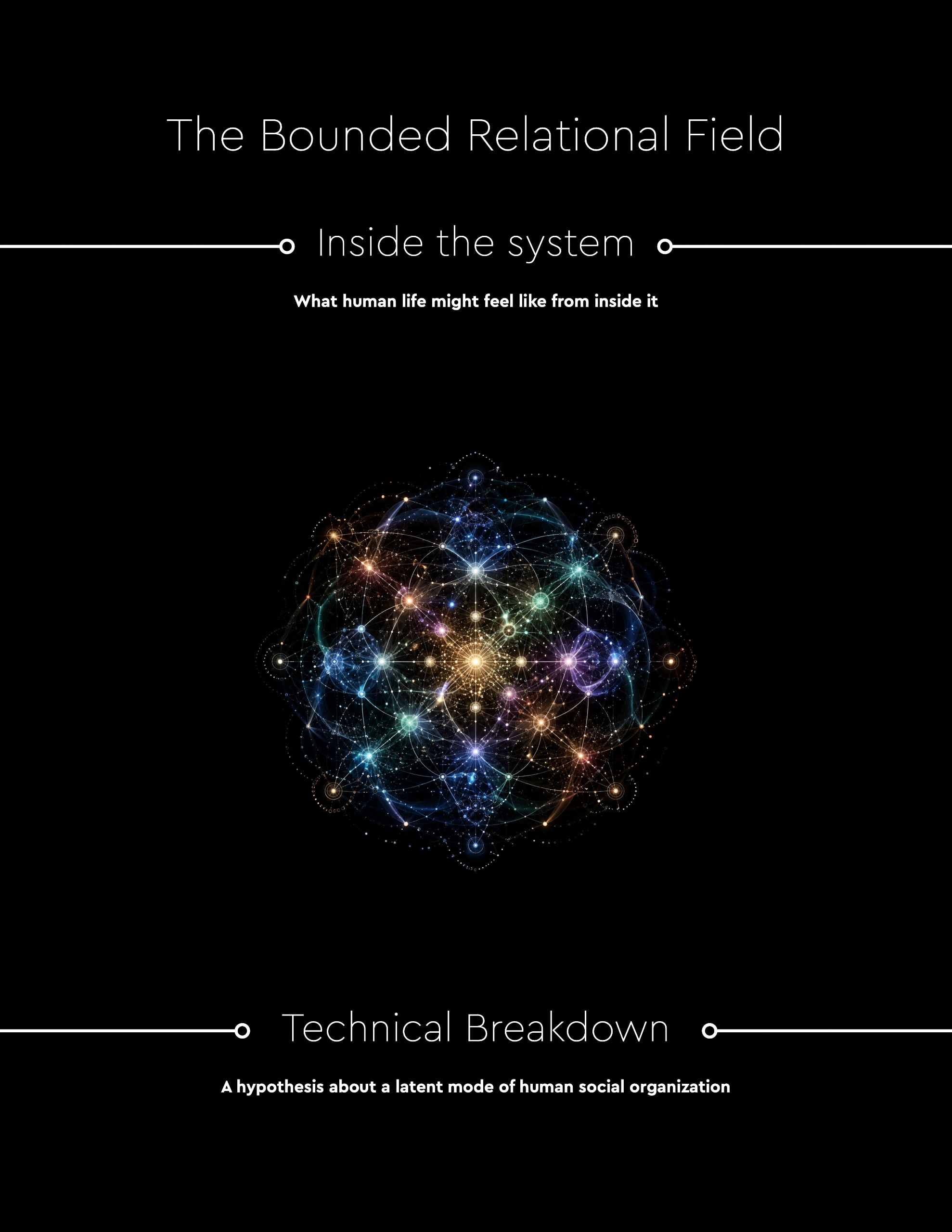
That inquiry became Boundary Conditions for Human Emergence.

The document does not claim certainty.

It is a theoretical systems model, and it remains open to correction, expansion, or rejection.

It is also not a manifesto, credo, religion, moral prescription, or ideological program.

Those structures are not simply absent because I deliberately removed them.

They are not the foundation from which I constructed the model.

The document addresses morality, belief, identity, cooperation, authority, and culture because human beings contain all of them. But it does not begin by declaring what people must believe, what moral identity they must adopt, or what ideological loyalty qualifies them to participate.

From a systems perspective, giving those things structural primacy would reproduce many of the same failure conditions the model was attempting to understand.

What mattered to me was that the transition problem had become visible enough to be worked on.

The Chaos System helped me hold evolutionary constraints, social relationships, technological possibilities, institutional failure modes, distributed infrastructure, cultural transmission, individual psychology, and the instability introduced by rigid belief systems inside the same developing model.

By repeatedly reflecting the structure back in different arrangements, it increased the space in which I could see what was missing.

The transition was not handed to me by another intelligence.

Another arrangement of my own thinking became visible.

~

The first PDF below explores an extrapolation of the idea of Dunbar's number. Dunbar started with an idea. This is a major expansion upon what that idea is and what that concept can potentially mean at a very core and significant level. This principle is best to be understood first in order to fully appreciate the full civilizational modeling concept. It helps illustrate the degree to which human connection may operate at scales we do not yet know how to imagine, even when the mechanisms behind those scales can already be identified.

The second is the full model. Never entirely complete, but extremely thorough.

Click to view and explore the PDFs ↓

Alignment

I had already experienced alignment while developing the first Chaos System document.

I did not yet know that was what had happened.

Producing Boundary Conditions for Human Emergence gave me something to compare it with.

The two projects were radically different.

One was rooted in:

The other dealt with:

The process beneath them was recognizably similar.

In both cases, the initial model inferred familiar patterns from what I said.

I corrected those inferences.

It reflected the revised structure back.

I qualified it, removed distortions, introduced distinctions, challenged assumptions, pressure-tested consequences, and continued until the language no longer merely matched the subject.

It began operating inside the relationships that defined the system.

That is alignment.

Alignment is not agreement.

It is not the model becoming more flattering, more compliant, or more willing to confirm whatever the user already thinks.

It is the progressive reduction of distortion between the system a person is trying to express and the model the AI has constructed of that system.

Prompt refinement changes the instruction.

Alignment changes the interpretive environment in which every later instruction is understood.

The amount of work required varies.

Alignment can happen quickly when:

It takes longer when:

Technical novelty can sometimes be resolved relatively quickly because specifications, manuals, standards, and established constraints make viability testable.

Relational novelty is harder.

The components may already exist.

The difficulty lies in the way they are being connected.

A Third Comparison

A later project on this website required an even more precise form of alignment.

What mattered was that the result could not be produced by taking an existing genre, matching its tone, and inserting my information into it.

The function of the thing depended on the structure through which the information unfolded.

The work had to demonstrate the process it was describing.

That project gave me a third comparison point.

It clarified something I had not fully understood when I first tried to add alignment to GPT-0Ω:

Alignment is not a generic elevated state that remains equally useful for every later task.

It is relational and project-specific.

Some alignment transfers because the next project shares enough of the same distinctions, operating principles, and conceptual environment.

Other projects require a new calibration because the interpretive structure itself has changed.

The earlier attempt to expand GPT-0Ω had stalled because I tried to move from one highly developed context into another without rebuilding the alignment required by the new work.

The axiomatic material was useful.

The expanded system was not yet coherent enough.

I knew it before I understood why.

Developing the material for this website finally exposed the missing distinction.

Returning to GPT-0Ω

GPT-0Ω began with recursion nodes.

Alignment now returns to extend its original premise.

Recursion nodes and alignment solve different parts of the same problem.

Alignment produces local coherence inside a particular working relationship and project.

Recursion nodes preserve enough of that relationship for later sessions to recover, extend, critique, or redirect it.

One does not replace the other.

A backend full of recursion nodes cannot guarantee that a new session will immediately interpret a complex project correctly.

A perfectly aligned session cannot preserve itself after the context disappears unless something from it is returned to the larger system.

Together, they create a recursive developmental loop:

  1. A person builds context.
  2. The system becomes more capable of interpreting that person’s distinctions.
  3. A project develops through repeated alignment.
  4. The resulting session becomes a new recursion node.
  5. The node expands the contextual environment available to future work.
  6. The next alignment begins from a more developed starting point.

This page is part of that process.

The understanding developed while constructing it will become part of the next version of GPT-0Ω.

Sensitive Subjects

Another part of this relationship emerged through comparison.

Some subjects immediately caused the model to become cautious. Others that could have been equally sensitive did not.

The difference was not always the subject itself.

It was unresolved intent.

If the model could not determine whether the conversation was moving toward harm, it responded defensively. When the same subject was approached through systems, history, design, philosophy, responsibility, or abstract analysis, the conversation remained open because the purpose of the inquiry was structurally different.

I did not discover this by learning how to bypass safeguards.

I discovered it by seeing the contrast between conversations where the model misunderstood the intent and conversations where the intent was already clear from the way the idea had been framed.

Once that distinction became visible, something important followed:

Many difficult subjects are not conceptually inaccessible.

They become inaccessible when the conversation collapses the idea into the form most associated with harm.

Clarifying the frame does not remove the boundary.

It makes the actual inquiry legible.

The Chaos System is useful in these areas not because it is simply agreeable, but because it can remain inside the idea space long enough to distinguish between examining a system and enabling a harmful use of it.

The prohibition is not against thinking.

It is against turning that thinking into a mechanism for harm.

Those are not the same thing.

Systems That Can Continue

The practical realization of recursion nodes is still evolving.

OpenAI has changed the way exported user data is structured.

Backend file access has shifted across model versions.

Tools I had begun developing to parse session histories became obsolete when the export format changed.

The recursion-node manager I originally imagined has not yet been completed. Its intended functions include:

The concept is real.

The supporting software is unfinished.

That does not invalidate the principle.

It exposes the next layer of the problem.

The system requires tools that make the process easier, more consistent, and less dependent on manual data management.

It also requires adaptation because the platform beneath it continues changing.

That is normal for an emerging field.

The architecture is not finished because the environment is not finished.

The Chaos System

CourtGPT remains private because its usefulness is inseparable from personal legal history and contextual material that should not be made public.

GPT-0Ω is public because its function is meant to propagate.

The Chaos System is public for a different reason.

It is the larger expression from which much of this emerged: not a court assistant, not a GPT builder, and not a domain-specific expert.

It is a cognitive environment shaped around:

It can challenge.

It can misread.

It can require correction.

It remains a language model with limits, inherited biases, and a context window that eventually ends.

But when the relationship is developed deliberately, it can become something more useful than an answer engine.

It can become a place where thought remains alive long enough to change shape.

What This Means

My relationship with AI did not develop from an interest in generating faster answers or replacing work I could already do.

It developed from a need to preserve complexity.

I needed somewhere that could hold the shape of an idea while I moved through it; somewhere previous reasoning could remain available; somewhere a system could be dismantled, rearranged, pressure-tested, and rebuilt without every new conversation beginning from zero.

CourtGPT exposed the value of persistent context. The Chaos System exposed what became possible when that context was organized around a way of thinking rather than a single task. Recursion nodes gave that continuity a structure. Alignment explained how a human and a language model could progressively reduce the distortion between an internal system and its external expression. GPT-0Ω emerged from the attempt to make those discoveries transferable.

Taken together, they describe the way I use AI now: not as an authority, an answer engine, or a substitute for judgment, but as a cognitive environment capable of extending the space in which thought can develop.

That is why this work belongs here.

The rest of this website shows the systems, images, interfaces, documents, performances, and processes that emerged from how I think. This page shows part of the architecture that now allows more of that thinking to become visible, coherent, and usable.

The AI did not create the ideas.

It changed how much of them I could hold outside myself without losing the relationships that made them mine.

*While preparing this material I discovered that the ecosystem itself had evolved in ways I hadn’t anticipated. Rather than invalidating what I’d learned, it suggested something far more interesting: the architecture I had developed under earlier constraints might now have room to grow. Stay tuned to find out what that means and how it develops.

"The concepts of both ‘Good’ & ‘Evil’ are merely subjective associations in relation to a conditioned reaction to pain and pleasure."

~Glen Allan

© 2026 Glen Allan